
Though considered a commonly used component of the digital ecosystem, Artificial intelligence (AI) has evolved at an accelerated rate into the lives of children. It can now be found at home in smart toys and wearables, in scholastic environments, and in other public places children frequent, and is being used by children in ways that did not exist several years ago. Ensuring that children’s privacy is protected now and in the future is critical, however the accelerated growth of AI Technology for children has stirred up the widely debated conversation over the ethics of its use.
With a shared interest in this topic, Springboard Policy joined IAB Canada to present a recent report, created in partnership with the Canadian Standards Council, on AI and children’s privacy. The report unpacked key areas of risk:
- Data (i.e.: magnitude, or disclosure)
- Functionality (i.e.: profiling, inference and re-identification)
- Oversight (i.e.: bias, transparency and accountability)
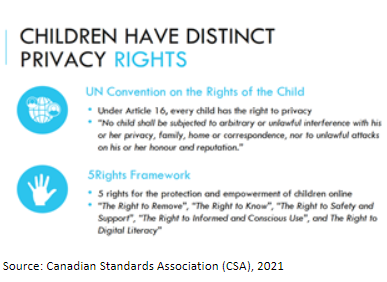
Covering off interventions throughout the AI life cycle – from development to adoption, Jasmine Irwin, Senior Associate at Springboard Policy, along with her colleague, Alannah Dharamshi, Associate, outlined the fact that children have distinct privacy needs, as defined by the UN Convention on the Rights of the Child, creating a 5Rights Framework to consider:
Of equal importance is the fact that children have distinct circumstances which need to be taken into consideration:
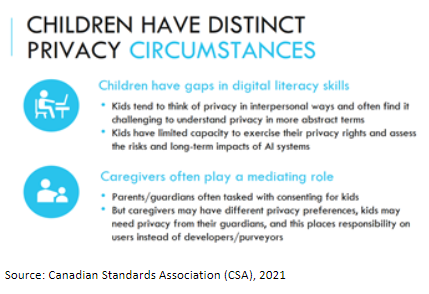
It was made clear that we have a generation gap and that a lot of this is unchartered territory. In many cases, we are attempting to leverage old rules that no longer align with the age of AI, and adult-centric approaches may not work. Children also have differing needs that need to be addressed.
What was also made abundantly clear is that, when it comes to children, they care about their privacy and Canadian policies continue to evolve to reflect this. It is therefore incumbent upon the industry to make the right choices and not risk or jeopardize this segment for the sake of short-term gains. AI urgently needs to be thought through for children’s use-cases.
CSA Group concluded that it is imperative for any strategy that involves AI to implement a child-centric approach that takes into consideration children’s privacy rights, distinct needs and unique circumstances, and keeps them front and center.
To join our AI Working Group, please reach out to: [email protected]
To obtain a recording of this session, you can find it here.